

Lock the apps you lose time to.
Pick them, and they stay shut until you’ve stretched.
A minute of stretching opens them for ten minutes, or choose longer for either. It counts the time you hold a stretch, never your score, so a stiff body unlocks as fast as a flexible one. If you can’t stretch right now, one button opens them anyway after thirty seconds.
Apple’s Screen Time does the locking, and Otter Stretch never learns which apps you chose. Part of Otter Stretch Full.
-

Locked until you stretch
-

A minute later, open for ten
It never asks you to go deeper.
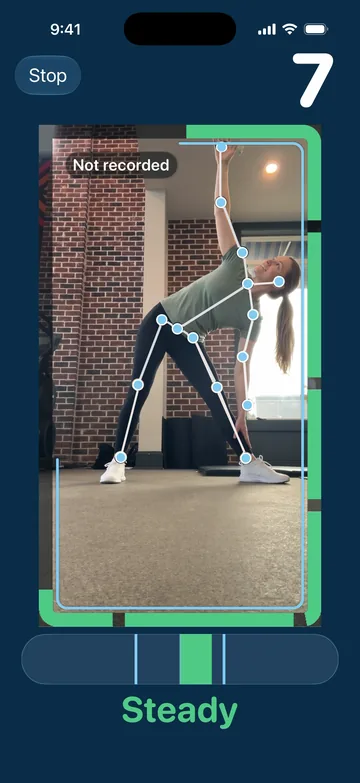
Points come from how steadily you hold the spot you picked. Depth earns nothing.
Pushing past your range is how beginners get hurt, so the game doesn’t pay for it. It only makes you wobble, and wobbling is what costs you gaps.
It is also what the research says. A 2024 review of 77 stretching studies found that people who held a gentle stretch gained as much range as people who pushed to the point of pain.
It starts with what’s tight.
- Can’t touch my toes
- Stiff hips
- Stiff lower back
- Tight quads
- Tight glutes
- Tight inner thighs
Pick what bothers you and it builds a three-stretch routine named after it. Or pick one stretch.

What you get for turning up
- Whiskers, every session. They only go up, and they are what your streak is made of.
- A chime for every gap. Ten to twenty a round, and a round is under a minute a side.
- Your range, every two weeks. Once you’ve done a stretch five times, you see how far you comfortably hold it. It moves once a fortnight, from your last five sessions, so one stiff day can’t knock it back.
- Free swim. The otter with no stretching in it, for when you just want to play.
Thirty stretches
Stretches and balance poses, standing, on a chair and on the floor, each one shown and spoken before the clock starts. A session is one stretch or a routine of a few, and either way it is under ten minutes.
Standing stretches
- Toe touchFold forward and hang — listen for tones
- Side bendLean sideways, don't twist
- Hamstring stretchLean out and reach down your leg
- Quad stretchPull your heel toward your seat
- Side lungeSink onto the bent knee
- Elevated leg reachLeg straight, reach down it
- Chest openerArms straight, lift your hands away
- Calf stretchLean forward over your front knee
Standing poses
- TriangleHand on your shin, other arm up, chest open
- Warrior IArms up if that's comfortable
- Warrior IIBend one knee out over its foot, other leg straight
- Warrior IIIArms forward, one line from fingers to heel, only as far as feels steady
- Chair poseArms forward or up, and hold
- GoddessBend both knees and sink straight down
- Single-leg standLift the other foot a couple of inches and hold it steady
- Standing knee liftStand tall and hold it steady
- Tree poseHands overhead, or one on the chair, and hold it steady
- Side leg liftA little is plenty: keep your hips level and hold it steady
On a chair
- Seated side bendLean sideways, don't twist
- Seated hamstring reachHinge at your hips, reach down it
- Overhead reachHold them overhead, as high as is comfortable
- Seated knee hugHold it with both hands, toward your chest
- Cross-body shoulder stretchHold the elbow with your other hand
- Seated figure-fourLet that knee sink, and lean forward a little if it's comfortable
- Neck side tiltShoulders stay down, nose stays forward
On the floor
Your iPhone’s camera wasn’t built for stretching.
We taught it.
Apple’s body tracking expects someone standing up. Fold over your knees or kneel on the floor, and it loses you.
So we recorded real stretching sessions and replayed them. We fixed what our algorithm got wrong. Then we did it again, round after round. We tested it with teenagers, Division I athletes, middle-aged adults and seniors. That’s why Otter Stretch keeps up with you.
What regular stretching does, measured.
A muscle held for about thirty seconds, a few times a day, is measurably looser within weeks, and a gentle hold gains as much as a hard one. Desk discomfort eases while you keep at it. Stretching does not prevent injury, fix posture or improve sleep.
The four findings, with their sources. None of them is a study of Otter Stretch; the app is a way to do it every day.